
4 Best Kitchen Countertop Storage Picks in 2026
As an Amazon Associate, this website earns from qualifying purchases.
The short answer
Countertop storage works best when it earns its footprint twice. An airtight container turns loose bags into a stackable block, and a stackable shelf doubles a cabinet's usable space, without claiming new floor area.
Last updated September 2026
Contents11
- #1. OXO Good Grips POP Container (4.4 qt): best for everyday dry goods
- #2. 10 Strawberry Street Ceramic Canister Set (3-piece): best for a display-worthy counter
- #3. Rubbermaid Brilliance Pantry Food Storage Container Set: best for a full matched system
- #4. SONGMICS Cabinet Organizer Shelves (set of 2): best for reclaiming cabinet space
- Factors to consider when choosing countertop storage
- When a rolling cart is the better fix
- Which one solves your actual problem
- What to check before buying
- A short list of what not to do
- How we picked these countertop storage picks
- Who this page is for
Our top 4 picks
- 1Best for everyday dry goods
 OXO Good Grips POP Container (4.4 qt)
- 4.4 quart airtight container for pantry staples
- Push-button lid creates an airtight seal
- Stackable, space-efficient design
- 2Best for a display-worthy counter
 10 Strawberry Street Ceramic Canister Set (3-piece)
- Three canisters sized 24, 38 and 72 fluid ounces
- Ceramic lids with a silicone gasket seal
- Embossed geometric design in white
- 3Best for a full matched system
 Rubbermaid Brilliance Pantry Container Set (8-piece)
- Set of four containers with lids, eight pieces total
- Sizes from 3.2 cups to 16 cups
- Crystal-clear, BPA-free Tritan lids and bases
- 4Best for reclaiming cabinet space
 SONGMICS Cabinet Organizer Shelves (set of 2)
- Set of two shelves, one slightly smaller than the other
- Made from engineered wood and metal
- Each shelf holds up to 33 pounds
A lot of what looks like a kitchen countertop storage problem is really a container or cabinet problem. Loose bags and boxes take up more room than the food inside them needs. A full cabinet pushes overflow onto the counter. These four picks fix both sides of that problem.
#1. OXO Good Grips POP Container (4.4 qt): best for everyday dry goods
OXO Good Grips POP Container (4.4 qt)
Our verdict:
Best for everyday dry goods
Best for flour, sugar, or pasta that needs a fast, one-hand airtight seal.
View on Amazon- 4.4 quart airtight container for pantry staples
- Push-button lid creates an airtight seal
- Stackable, space-efficient design
- Dishwasher safe and BPA-free
Keep in mind: it comes as a single container, so building a full matched set means buying pieces one at a time.
Product details checked September 2026
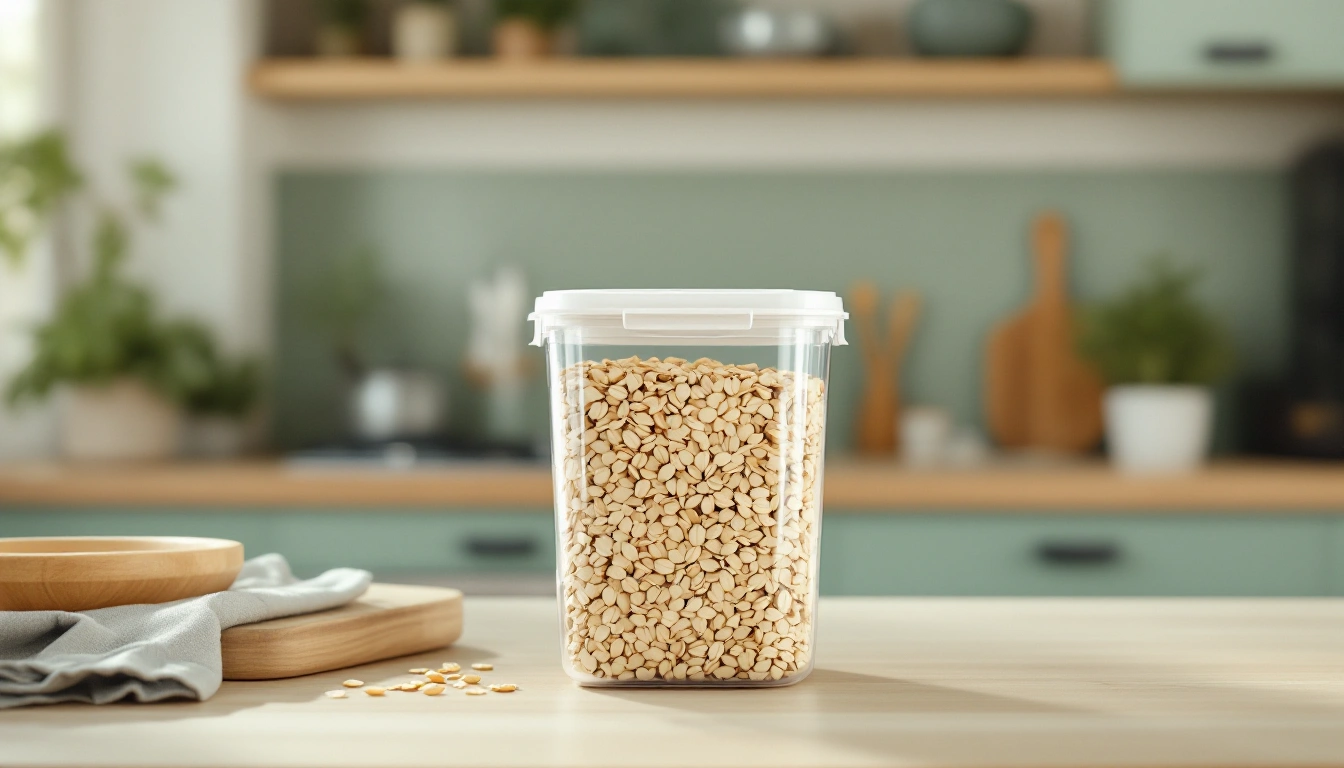
A push-button lid activates a silicone seal with one hand. That matters once you're opening a container daily. This size roughly matches a five-pound bag of flour or sugar, for a clean, one-time transfer. It stacks, and it's dishwasher safe.
#2. 10 Strawberry Street Ceramic Canister Set (3-piece): best for a display-worthy counter
10 Strawberry Street Ceramic Canister Set (3-piece)
Our verdict:
Best for a display-worthy counter
Best for flour, sugar and coffee you want visible and within reach on the counter itself.
View on Amazon- Three canisters sized 24, 38 and 72 fluid ounces
- Ceramic lids with a silicone gasket seal
- Embossed geometric design in white
- Hand wash recommended
Keep in mind: ceramic is heavier and less impact-resistant than plastic, and hand washing is recommended.
Product details checked September 2026
This set includes three canisters in three sizes. Each ceramic lid has a silicone gasket to help keep contents fresh. The embossed white finish is meant to sit out rather than hide in a cabinet. That suits a counter that already doubles as display space.
#3. Rubbermaid Brilliance Pantry Food Storage Container Set: best for a full matched system
Rubbermaid Brilliance Pantry Container Set (8-piece)
Our verdict:
Best for a full matched system
Best for committing to an entire shelf of clear, uniform containers instead of mismatched bags.
View on Amazon- Set of four containers with lids, eight pieces total
- Sizes from 3.2 cups to 16 cups
- Crystal-clear, BPA-free Tritan lids and bases
- Dishwasher and freezer safe
Keep in mind: building out a full pantry with this line costs more upfront than a single container.
Product details checked September 2026
Crystal-clear Tritan lids and bases with secure latches make this set fully airtight and, according to the listing, leak-proof. One lid size fits more than one container size in the set. That keeps a shelf of Brilliance containers looking uniform and stacking predictably.
#4. SONGMICS Cabinet Organizer Shelves (set of 2): best for reclaiming cabinet space
SONGMICS Cabinet Organizer Shelves (set of 2)
Our verdict:
Best for reclaiming cabinet space
Best for freeing up cabinet room so overflow items stop landing on the counter.
View on Amazon- Set of two shelves, one slightly smaller than the other
- Made from engineered wood and metal
- Each shelf holds up to 33 pounds
- Stacks, nests or sits in an L-shape
Keep in mind: the 33 lb. per-shelf rating suits jars and light dishware, not heavy cookware.
Product details checked September 2026
These two shelves come in two sizes. They can stack, nest together, or sit next to each other. That adds a second storage layer inside an existing cabinet. When a cabinet has more usable room, less overflow lands on the counter. That's often the real fix for clutter.
Factors to consider when choosing countertop storage
Seal quality over material
A good seal matters more than the material. Glass, plastic or ceramic all work if the lid keeps air out. Check for a gasket or multi-point latch rather than a lid that just rests on top.
Stacking shape
Square and rectangular containers use shelf and counter space better than round ones. They butt up against each other without wasted gaps.
What's actually cluttering the counter
If the problem is loose bags and boxes, containers fix it. Is a full cabinet pushing things onto the counter? Then a shelf inside the cabinet is the better fix.
When a rolling cart is the better fix
Some counter clutter is really a lack of workspace, not storage. If you have nowhere to set things down while you cook, containers won't help, since they add no prep surface. A folding cart like the Origami RBT does. Its wood top holds up to 100 lbs., and the shelves underneath hold up to 50 lbs. each.
Open, it measures about 25 by 20 inches. Folded, it is only 5.8 inches deep, so it can tuck beside the fridge or behind a door.
That only works if you have a spot to fold it into. If you don't, a smaller fixed cart or a wall shelf fits better than a folding cart you never fold. Our kitchen storage cart picks compare four carts.
Which one solves your actual problem
If the counter is cluttered because there's nowhere to work, a cart solves it better than containers. If it's cluttered because loose bags and half-empty jars have no home, containers solve it better than a cart. A cart just gives that clutter a new place to spread.
Many kitchens use both: a folding cart for surface when you need it, and a container system that keeps dry goods tidy either way.
What to check before buying
For containers, match capacity to how you actually buy food. The OXO POP 4.4 qt size holds about 5 lbs. of flour or sugar, so a 5 lb. bag transfers in one go with nothing left over. If you buy in bulk, a set with several sizes, like the Rubbermaid Brilliance set with its 16, 12, 7.8 and 3.2 cup containers, covers more of your pantry at once.
For a cart, check the folded size as well as the open size. Folded still takes up space, and it needs a real spot to live between uses.
A short list of what not to do
Don't mix container brands and expect them to stack like a matched set. Different lines are rarely built to the same footprint, so you end up with gaps and wasted shelf space. And don't buy a big fixed cart for a kitchen that can't spare the floor space just because it looks sturdier.
How we picked these countertop storage picks
We looked for two kinds of product. Some seal and stack food better than its bag or box. Others free up cabinet space so less spills onto the counter. We did not test these products by hand. Details come from each listing, so check the current page before you buy.
Keep the work surface usable between larger sorting jobs
To keep counters clear through the week, return loose tools and check one storage zone during a short weekly routine. Note the group that keeps landing on the counter so the next storage change has a clear purpose.
Who this page is for
This page is for a cluttered counter. It helps you tell if you need better containers or more cabinet room. For a deeper look at container systems alone, see our kitchen food storage containers guide.
Questions people also ask
Do airtight containers actually save counter space?
Yes, mainly because they stack. A shelf of uniform square containers takes up less room than the same food in its original bags and boxes, which are usually irregular shapes.
Can I mix container brands on the same counter?
You can, but containers from the same line usually stack and nest more predictably, since their footprints are designed to match. Staying within one line gets you closer to a uniform look.
Is a stackable cabinet shelf really countertop storage?
It counts here because it frees up counter clutter indirectly: items that would otherwise sit out because a cabinet is full get a home when a stackable shelf adds space inside it.