
4 Best Kitchen Storage Carts in 2026
As an Amazon Associate, this website earns from qualifying purchases.
The short answer
Mobility is the whole point of a storage cart. The Origami folding cart gives up permanence for floor space you get back on demand, while the Seville Classics cart trades folding for the highest weight capacity here.
Last updated October 2026
Contents10
- #1. Origami RBT Folding Kitchen Cart: best folding cart
- #2. Seville Classics 3-Tier UltraDurable Utility Cart: best for maximum weight capacity
- #3. HOMCOM 32.75 in Kitchen Island Cart: best compact enclosed cart
- #4. Amazon Basics 3-Tier Rolling Kitchen Rack: best budget rolling cart
- Factors to consider when choosing a storage cart
- Matching the cart to the job
- Floor protection and moving it around
- Matching capacity to what you'll actually load
- How we picked these storage carts
- Who this page is for
Our top 4 picks
- 1Best folding cart
 Origami RBT Folding Kitchen Cart
- Steel frame cart with three tiers and a wood top
- Unfolds in under five seconds, no assembly needed
- Holds up to 200 pounds across the top and shelves
- 2Best for maximum weight capacity
 Seville Classics 3-Tier UltraDurable Utility Cart
- Three steel wire shelves adjust in one-inch steps
- Measures about 36 inches wide by 18 deep by 32 tall
- Holds up to 500 pounds evenly distributed across the cart
- 3Best compact enclosed cart
 HOMCOM 32.75 in Kitchen Island Cart
- Rubberwood top over an MDF frame
- One drawer and a cabinet with an adjustable shelf
- Four swivel casters, two with brakes; towel rail doubles as a handle
- 4Best budget rolling cart
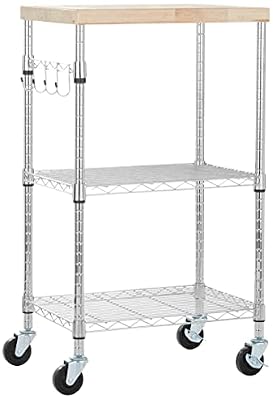 Amazon Basics 3-Tier Rolling Kitchen Rack
- Chrome-plated steel frame with two shelves and a wood top
- Each shelf holds up to 50 pounds
- Shelf height adjusts in one inch increments
Every kitchen storage cart on this page rolls, but they don't all fold. That difference matters more than most spec sheets suggest. These four picks range from a fold-flat cart for tight kitchens to an enclosed cart with drawers.
#1. Origami RBT Folding Kitchen Cart: best folding cart
Origami RBT Folding Kitchen Cart
Our verdict:
Best folding cart
Best for a kitchen that genuinely can't spare permanent floor space and has somewhere to fold the cart to.
View on Amazon- Steel frame cart with three tiers and a wood top
- Unfolds in under five seconds, no assembly needed
- Holds up to 200 pounds across the top and shelves
- Folds down to 5.8 inches deep for storage
Keep in mind: it lacks enclosed drawer or cabinet storage.
Product details checked September 2026
A powder-coated steel frame with a wood countertop rated for 100 pounds sits over shelves rated 50 pounds each, for 200 pounds total. It unfolds in under 5 seconds and folds flat again on 4 casters when you're done. No other cart here does that.
#2. Seville Classics 3-Tier UltraDurable Utility Cart: best for maximum weight capacity
Seville Classics 3-Tier UltraDurable Utility Cart
Our verdict:
Best for maximum weight capacity
Best for a cart you want to load heavily and see the contents of at a glance.
View on Amazon- Three steel wire shelves adjust in one-inch steps
- Measures about 36 inches wide by 18 deep by 32 tall
- Holds up to 500 pounds evenly distributed across the cart
- Four-inch wheels, two locking; NSF certified for dry environments
Keep in mind: it has no doors or drawers, so everything on it stays visible.
Product details checked October 2026
This steel-wire cart holds up to 500 lbs. in total across three open shelves. The shelves adjust in one-inch steps, and four-inch wheels include two brakes. With its handle, the maker lists a 35.9-inch width, 18-inch depth and 32.2-inch height.
It is NSF certified for dry environments and needs no tools to assemble. Leave enough room for the handle and a clear path before loading it.
#3. HOMCOM 32.75 in Kitchen Island Cart: best compact enclosed cart
HOMCOM 32.75 in Kitchen Island Cart
Our verdict:
Best compact enclosed cart
Best for a kitchen that wants a wood worktop and hidden storage in a smaller cart.
View on Amazon- Rubberwood top over an MDF frame
- One drawer and a cabinet with an adjustable shelf
- Four swivel casters, two with brakes; towel rail doubles as a handle
- Measures 32.75 inches wide by 17.75 deep by 36 tall
Keep in mind: it has one drawer and no open storage shelf; measure space for the cabinet doors too.
Product details checked October 2026
A rubberwood top sits over one drawer and a double-door cabinet. The inner shelf has three height settings. Four swivel casters, two with brakes, let you park the cart for use or move it for cleaning.
At 32.75 inches wide and 17.75 deep, it takes less floor width than the larger islands here. It has an MDF frame, so keep spills from sitting against the base.
#4. Amazon Basics 3-Tier Rolling Kitchen Rack: best budget rolling cart
Amazon Basics 3-Tier Rolling Kitchen Rack
Our verdict:
Best budget rolling cart
Best for a lower-cost cart for a microwave, mini fridge, or general extra storage.
View on Amazon- Chrome-plated steel frame with two shelves and a wood top
- Each shelf holds up to 50 pounds
- Shelf height adjusts in one inch increments
- Four caster wheels, two of them locking
Keep in mind: its 175 lb. total rating calls for careful load planning; keep heavy items low.
Product details checked September 2026
A chrome-plated steel frame with 2 shelves and a wood top holds up to 175 lbs. total. Each shelf adjusts in 1 inch increments. Four caster wheels, 2 of them locking, and 4 included hooks round out a plain, no-frills cart.
Factors to consider when choosing a storage cart
Folding versus fixed
A folding cart gives up some sturdiness for the ability to disappear when you don't need it. A fixed cart trades that flexibility for more consistent capacity and a simpler structure.
Open shelving versus enclosed storage
Open carts are faster to load and let you see everything at a glance. Enclosed carts with drawers or cabinets hide clutter but take a moment longer to access.
Wheel type
If the cart will mostly sit in one spot, locking casters keep it from drifting during normal use. If you're moving it around often, non-locking wheels roll more freely.
Matching the cart to the job
For extra prep space, you want a sturdy, flat top, like the Origami's wood countertop rated for 100 lbs. To hold bulky or heavy items, raw capacity matters most, like the Seville Classics cart's 500 lb. rating. If the cart should blend in with cabinets rather than look like utility gear, the compact HOMCOM has one drawer and a cabinet under a rubberwood top. For a microwave or a small fridge, the Amazon Basics rack has shelves that adjust in 1-inch steps.
If you need open storage for heavy loads but never plan to move it, a fixed rack may suit you better than a cart. Our kitchen storage racks page compares those.
Floor protection and moving it around
Casters that roll well on tile or hardwood can behave differently on a rug or a raised strip between rooms. Think about where the cart will actually travel, not just where it will sit. A cart that moves a few feet within the kitchen has an easier job than one you roll between rooms every day. Hard casters can mark soft flooring over time, so a felt pad or mat under a cart that mostly stays put is cheap protection.
Matching capacity to what you'll actually load
It's easy to buy for the heaviest load you can imagine and end up with a cart that's too big for daily use. Think about what you'll really put on it.
A cart for extra prep space at holiday meals has different needs from one that holds a microwave every day. Check each shelf's rating, not just the total.
The Amazon Basics rack lists 175 lbs. in total but 50 lbs. per shelf, and the Origami splits its 200 lbs. between the top and the shelves.
How we picked these storage carts
We compared carts on mobility, weight capacity, and whether storage is open or enclosed, to cover different kitchen needs from a fold-away option to maximum capacity. We did not test these products by hand. Details come from each listing, so check the current page before you buy.
Who this page is for
Use this comparison to weigh a rolling cart's mobility against its capacity and storage style. If you are choosing between a cart and a full island, read our kitchen storage island guide to see when an island suits the room.
Questions people also ask
Do rolling carts need locking wheels?
It depends on where you'll use it. If the cart mostly stays in one spot, locking wheels keep it from drifting while you lean on it. If you're moving it often, non-locking casters roll more freely.
How much weight can a kitchen cart hold?
It varies by model. The Seville Classics 3-Tier cart is rated for 500 lbs. total, while the Origami cart's countertop is rated 100 lbs. with 50 lbs. per shelf underneath. Check the specific model before loading anything heavy.
Is a folding cart sturdy enough for daily use?
A well-built folding cart, like the Origami with its steel frame, holds up fine for regular use. The fold is meant for storage between uses, not constant folding and unfolding.