
4 Best Utensil Drawer Organizers for Long Cooking Tools in 2026
As an Amazon Associate, this website earns from qualifying purchases.
The short answer
The OXO Expandable Long Tool Organizer is built specifically around long cooking tools with slots sized for their length. The OXO Expandable Kitchen Tool version is the looser, open-area alternative for the same category.
Last updated September 2026
Contents10
- #1. OXO Good Grips Expandable Long Tool Organizer: best defined slots by tool type
- #2. OXO Good Grips Expandable Kitchen Tool Organizer: best open-area alternative
- #3. madesmart Classic 3 Compartment Utensil Tray: best for a general mix alongside long tools
- #4. Totally Bamboo Expandable Drawer Organizer: best for long tools plus everyday utensils
- Factors to consider when choosing a utensil drawer organizer for long tools
- The sizing problem with standard compartments
- Defined slots or an open area
- How we picked
- Storing long tools upright as an alternative
- Who this guide is for
Our top 4 picks
- 1Best defined slots by tool type
 OXO Good Grips Expandable Long Tool Organizer
- Open design for long-handled tools like spatulas and tongs
- Adjustable divider to customize the layout
- Square corners for a clean fit in drawers
- 2Best open-area alternative
 OXO Good Grips Expandable Kitchen Tool Organizer
- Adjustable dividers to customize compartment sizes
- Storage cup for small items like corn holders
- Square corners to eliminate gaps in drawers
- 3Best for a general mix alongside long tools
 madesmart Classic 3 Compartment Utensil Tray
- Three spacious compartments for kitchen utensils
- Measures 16 by 13 by 1.87 inches
- Soft-grip lining and nonslip rubber feet
- 4Best for long tools plus everyday utensils
 Totally Bamboo Expandable Drawer Organizer
- Expands from 13 to 22 inches wide
- Five compartments, three fixed and two sliding
- Measures 17.75 inches deep by 2.5 inches high
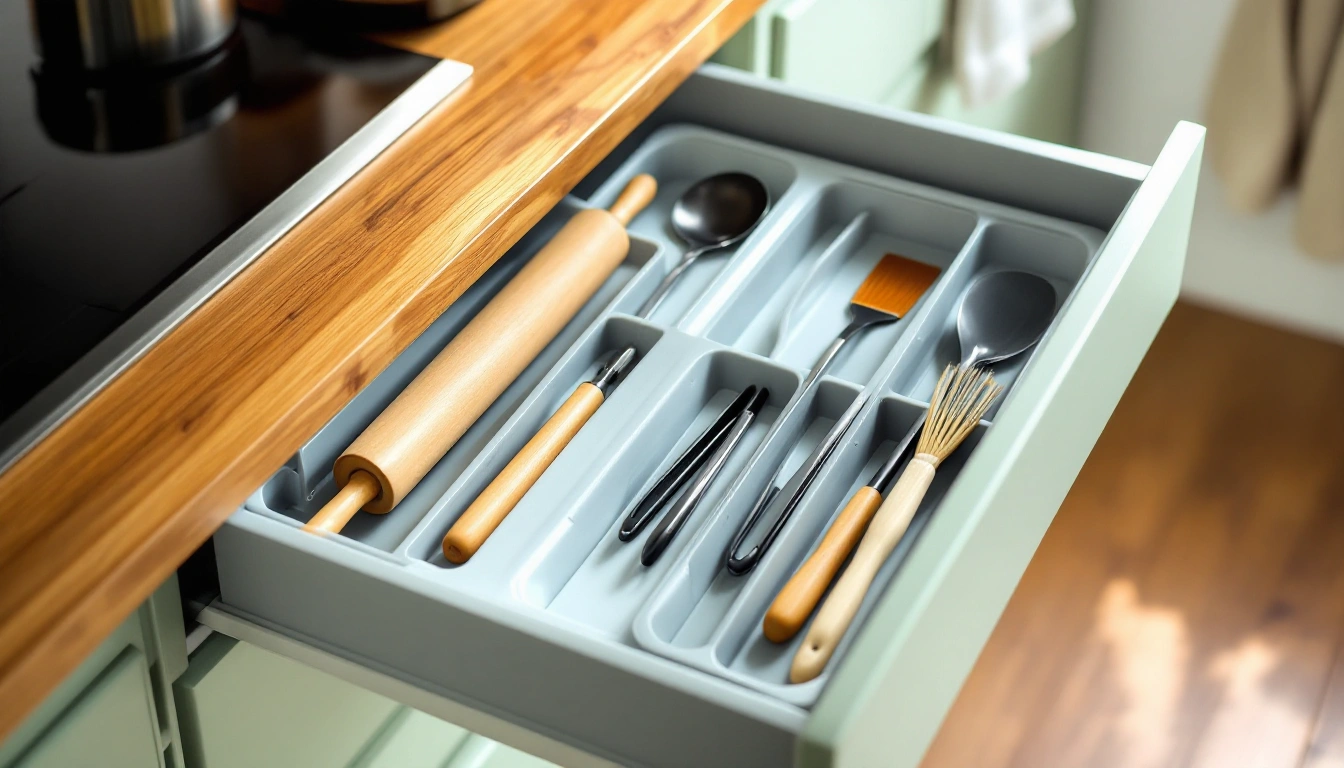
A utensil drawer organizer built for long cooking tools fixes a problem shorter trays create. Spatulas, whisks, tongs, and wooden spoons run longer than forks and spoons. A fork-sized slot leaves them overhanging the edge. This guide compares four picks that fit long tools properly.
We did not test these by hand. The facts below come from each listing. Check the current page before you buy.
#1. OXO Good Grips Expandable Long Tool Organizer: best defined slots by tool type
OXO Good Grips Expandable Long Tool Organizer
Our verdict:
Best defined slots by tool type
Best for giving each long cooking tool, like a whisk or a set of tongs, its own sized slot.
View on Amazon- Open design for long-handled tools like spatulas and tongs
- Adjustable divider to customize the layout
- Square corners for a clean fit in drawers
- Non-slip feet keep it in place
Keep in mind: placing dividers to match your tools takes more setup than an open-area design.
Product details checked September 2026
This organizer uses dividers sized for whisks, tongs, wooden spoons, and spatulas. Each type gets its own slot built to its actual length. There are no one-size-fits-all rows.
#2. OXO Good Grips Expandable Kitchen Tool Organizer: best open-area alternative
OXO Good Grips Expandable Kitchen Tool Organizer
Our verdict:
Best open-area alternative
Best for a looser layout where long tools share open space rather than individual slots.
View on Amazon- Adjustable dividers to customize compartment sizes
- Storage cup for small items like corn holders
- Square corners to eliminate gaps in drawers
- Tool-free installation
Keep in mind: tools can shift and overlap within the open space, which is less tidy over time than defined slots.
Product details checked September 2026
This version has an open area built for long-handled tools. It is quicker to load. You do not have to decide in advance exactly where each tool goes.
#3. madesmart Classic 3 Compartment Utensil Tray: best for a general mix alongside long tools
madesmart Classic 3 Compartment Utensil Tray
Our verdict:
Best for a general mix alongside long tools
Best for a drawer where long tools share space with everyday cutlery or other kitchen items.
View on Amazon- Three spacious compartments for kitchen utensils
- Measures 16 by 13 by 1.87 inches
- Soft-grip lining and nonslip rubber feet
- Made from BPA-free plastic
Keep in mind: its three sections are wide and general, not sized to any one long tool type specifically.
Product details checked September 2026
This tray has a soft-grip lining and a non-slip base. Its wide sections fit longer tools better than a tray built strictly for forks and spoons.
#4. Totally Bamboo Expandable Drawer Organizer: best for long tools plus everyday utensils
Totally Bamboo Expandable Drawer Organizer
Our verdict:
Best for long tools plus everyday utensils
Best for a drawer mixing long cooking tools with everyday utensils and a few serving pieces in one spot.
View on Amazon- Expands from 13 to 22 inches wide
- Five compartments, three fixed and two sliding
- Measures 17.75 inches deep by 2.5 inches high
- Bamboo sidewalls with a fiberboard base
Keep in mind: its five sections split space across several item types, so fewer slots go to long tools alone than a dedicated organizer.
Product details checked September 2026
This tray expands from 13 to 22 inches with five sections. Some sections fit larger tools and serving pieces alongside everyday items.
Factors to consider when choosing a utensil drawer organizer for long tools
Plan around length, not just tool count
It is tempting to shop based on how many utensils you own. Length is the more important number. Lay out your actual long tools and note the longest ones. That length decides whether a given organizer's slots will fit everything without overhang.
Decide between defined slots and open space
If you know exactly which long tools you are storing, and want each one to have a specific spot, defined slots are the better fit. If your collection of tools changes often, an open area is more forgiving.
Check drawer depth as well as slot length
Long cooking tools are often thicker in the handle than eating utensils. Silicone-headed spatulas are a good example. Check the organizer's height against your thickest tool. Make sure the drawer still has room to close.
The sizing problem with standard compartments
Most general drawer organizers assume a fairly uniform set of items, close in length to eating utensils. Cooking tools don't match that. A spatula or a long whisk dropped into a slot sized for a fork sticks out past the edge. It doesn't lie flat, it can catch as the drawer closes, and it works worse than a slot sized for it.
That is the problem a long-tool organizer solves. Its slots, or its open area, are sized for the tools you actually store, not a generic layout that holds them poorly.
Defined slots or an open area
The OXO Long Tool Organizer gives each type of tool its own slot. It stays tidy over time, since nothing shifts or overlaps. The trade-off is that you decide in advance where each tool goes.
The OXO Kitchen Tool Organizer takes a looser approach, with one extendable open area for long-handled utensils. Tools share the space instead of having set slots. It is quicker to load and suits a set of tools that changes often. It gets a bit less tidy over time, since tools can shift and overlap.
An open area is also more forgiving when your tools vary a lot in length. There is no risk of one extra-long tool not fitting a slot sized for something shorter.
How we picked
We looked for organizers built around length, not a general eating-utensil size. We covered both defined-slot and open-area approaches. We did not test these by hand. Details come from each listing, so check the current page before you buy.
Storing long tools upright as an alternative
Not every kitchen keeps long cooking tools in a drawer at all. A crock or canister on the counter, holding tools upright, is a common alternative for tools used daily during cooking. A drawer organizer still makes sense for tools used less often.
Who this guide is for
This guide is for someone storing long cooking utensils, like spatulas, whisks, and tongs. You want slots sized to fit them, not a general tray built for shorter eating utensils. For a broader comparison of OXO's expandable line, see our kitchen utensil drawer organizer picks.
Questions people also ask
Why don't regular utensil slots fit cooking tools well?
Most standard slots are sized closer to eating utensils, forks and spoons, which are shorter than cooking tools like spatulas, whisks, and tongs. A cooking tool in a fork-sized slot usually overhangs the edge or will not sit flat.
Should I keep cooking utensils in a separate drawer from eating utensils?
It is common to, mainly because the size difference means one slot style rarely serves both well. If they do share a drawer, a tray with an open area or longer slots handles both better.
What's the difference between adjustable dividers and an open area for long tools?
Adjustable dividers give each tool type its own defined slot. An open area lets tools share one space without fixed walls, which is quicker to load but less tidy over time.
How many long cooking tools does a typical organizer fit?
That depends on the organizer's width and your specific tools' size. An expandable design lets you match the organizer to your drawer's width, which affects how much total space you end up with.