
4 Best Kitchen Drawer Organizers for Mixed Tools in 2026
As an Amazon Associate, this website earns from qualifying purchases.
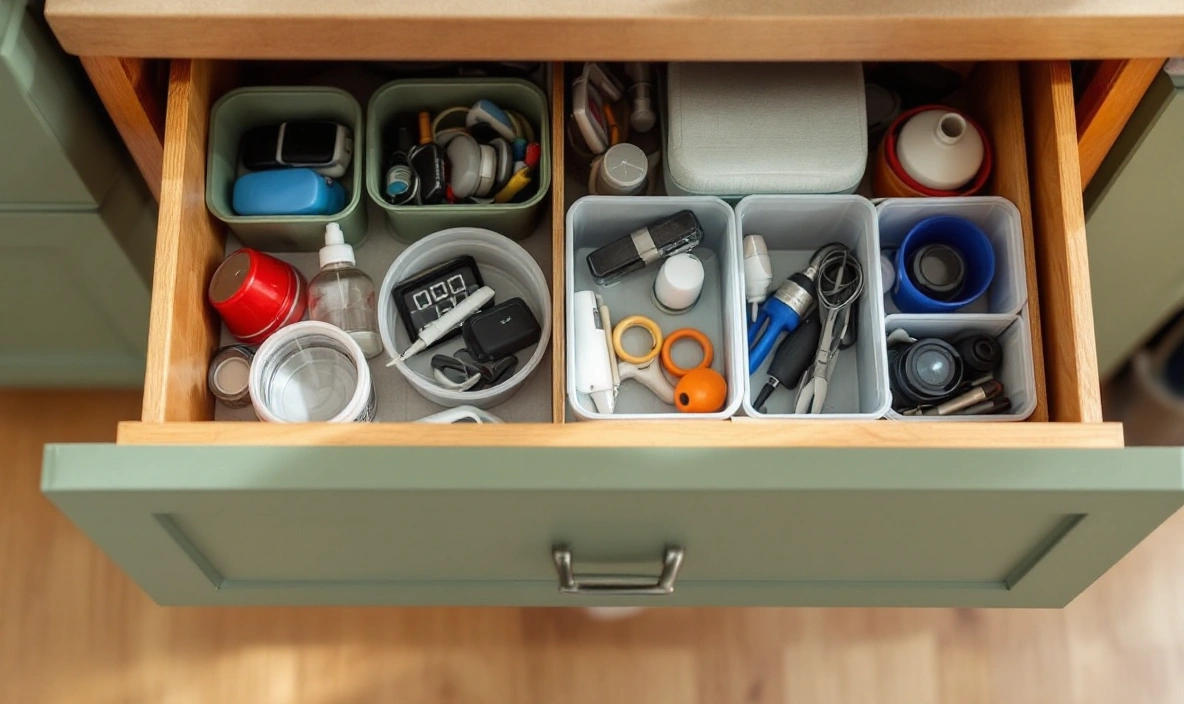
The short answer
The OXO Kitchen Tool Organizer handles long-handled tools well. The madesmart 3 Bin Set adds structure to a mixed drawer, and the Lifewit Drawer Dividers are the flexible default for whatever does not fit either.
Last updated October 2026
Contents12
- #1. OXO Good Grips Expandable Kitchen Tool Organizer: best for long-handled tools
- #2. madesmart Classic 3 Bin Drawer Organizer Set: best for adding structure to a mixed drawer
- #3. Lifewit 4 in Adjustable Drawer Dividers: best custom drawer layout
- #4. SpaceAid Bamboo Drawer Dividers: best bamboo option with labels
- Factors to consider when choosing a kitchen drawer organizer
- Why a fixed tray struggles with mixed contents
- Adding structure with a multi-piece set
- Handling long-handled tools separately
- Deciding what doesn't belong in the drawer at all
- Revisiting the drawer as habits change
- How we picked
- Who this guide is for
Our top 4 picks
- 1Best for long-handled tools
 OXO Good Grips Expandable Kitchen Tool Organizer
- Adjustable dividers to customize compartment sizes
- Storage cup for small items like corn holders
- Square corners to eliminate gaps in drawers
- 2Best for adding structure to a mixed drawer
 madesmart Classic 3 Bin Drawer Organizer Set
- Three bins in assorted sizes for one drawer
- Nonslip rubber feet and a soft-grip bottom
- Rounded corners for easy cleaning
- 3Best custom drawer layout
 Lifewit 4 in Adjustable Drawer Dividers
- Plastic divider walls let you choose your own drawer layout
- Top button adjusts and retracts each divider
- Spring tension and padded ends hold each wall in place
- 4Best bamboo option with labels
 SpaceAid Bamboo Drawer Dividers
- Four dividers with nine inserts for smaller compartments
- Expands from 17 to 22 inches long
- Each divider is 2.35 inches wide
A kitchen drawer organizer for a general drawer has a harder job than a utensil tray. This is the drawer holding gadgets, openers, measuring tools, and whatever else has no home. Mixed contents rarely fit the equal-sized rows a tray assumes. This guide compares four organizers built for that mixed job.
We did not test these by hand. The facts below come from each listing. Check the current page before you buy.
#1. OXO Good Grips Expandable Kitchen Tool Organizer: best for long-handled tools
OXO Good Grips Expandable Kitchen Tool Organizer
Our verdict:
Best for long-handled tools
Best for long-handled gadgets like tongs or a large slotted spoon that do not belong with smaller items.
View on Amazon- Adjustable dividers to customize compartment sizes
- Storage cup for small items like corn holders
- Square corners to eliminate gaps in drawers
- Tool-free installation
Keep in mind: its open area suits long tools, not a full mix of small gadgets, so pair it with dividers elsewhere in the drawer.
Product details checked September 2026
This organizer has an open area built for long-handled tools. It gives them a place to lie flat, without a full slot layout around them.
#2. madesmart Classic 3 Bin Drawer Organizer Set: best for adding structure to a mixed drawer
madesmart Classic 3 Bin Drawer Organizer Set
Our verdict:
Best for adding structure to a mixed drawer
Best for breaking one general drawer into a few defined zones instead of one open jumble.
View on Amazon- Three bins in assorted sizes for one drawer
- Nonslip rubber feet and a soft-grip bottom
- Rounded corners for easy cleaning
- Made from BPA-free plastic
Keep in mind: the three bins are separate pieces, so you decide the layout instead of getting one fixed tray shape.
Product details checked September 2026
Three bins in different sizes let you set aside one for measuring tools. Use one for openers and gadgets. Leave a smaller open area for the rest.
#3. Lifewit 4 in Adjustable Drawer Dividers: best custom drawer layout
Lifewit 4 in Adjustable Drawer Dividers
Our verdict:
Best custom drawer layout
Best for a drawer with mixed tools or wrap boxes that do not suit fixed tray slots.
View on Amazon- Plastic divider walls let you choose your own drawer layout
- Top button adjusts and retracts each divider
- Spring tension and padded ends hold each wall in place
- ABS plastic construction for kitchen tools and mixed drawer contents
Keep in mind: these walls are four inches high; check the height and length against your drawer.
Product details checked October 2026
Each divider is an ABS plastic wall. Put it where your tools need a slot. Press the top button to change its length. Spring tension and padded ends hold it in place. Check the clear span inside the drawer before buying.
The walls are four inches high. Check the space above them too. Measure from the base to the lowest point over the drawer. Leave room for the drawer to close without catching a wall. A shallow tray fitting there does not mean a tall wall will fit.
#4. SpaceAid Bamboo Drawer Dividers: best bamboo option with labels
SpaceAid Bamboo Drawer Dividers
Our verdict:
Best bamboo option with labels
Best for a mixed drawer you want to look a bit more finished, with labels to help everyone put things back correctly.
View on Amazon- Four dividers with nine inserts for smaller compartments
- Expands from 17 to 22 inches long
- Each divider is 2.35 inches wide
- Includes 30 label stickers, made from bamboo
Keep in mind: the dividers expand from 17 to 22 inches only, so measure a narrower drawer before buying.
Product details checked September 2026
Four bamboo dividers with nine inserts come with label stickers. Each zone can be marked for anyone using the kitchen. That helps a mixed drawer stay organized past the first week.
Factors to consider when choosing a kitchen drawer organizer
Sort before you buy anything
Take everything out of the drawer. Sort it into rough groups: things you use weekly, things you use rarely, and things that do not belong in this drawer at all. Organizing works better, with fewer compartments needed, once you thin out what does not need to be there.
Match the layout to what dominates the drawer
A fixed tray works when items are close in size, like a set of utensils. A general kitchen drawer rarely looks like that. Loose dividers let you build compartments around what you actually have. You do not need your items to match a pre-set shape.
Label zones if more than one person uses the kitchen
A small label on the drawer front helps everyone put things back correctly. A quick verbal note works too. This matters more in a mixed drawer than a utensil drawer, since the zones are not always as obvious as "forks go here."
Why a fixed tray struggles with mixed contents
A fixed tray works well when the items going into it are roughly the same size and shape, like a set of everyday utensils. A general kitchen drawer doesn't usually look like that. It might hold a can opener, a meat thermometer, measuring spoons, a garlic press and a handful of other odd shapes. None of them fit neatly into a row of identical slots.
Forcing these into a tray built for utensils means some items rattle around in big slots while others don't fit at all. The better approach is to build the compartments around what you actually have. Don't buy a layout first and hope your items match it.
Adding structure with a multi-piece set
Your drawer may have clear groups of items rather than pure clutter. Then a set of separate bins can work better than loose dividers alone.
The madesmart 3 bin set gives you a few tray sizes to work with. Give one bin to measuring tools and another to openers and gadgets. Leave some open space for whatever doesn't fit. That is a middle ground: more structure than dividers alone, but still flexible enough for a drawer that isn't strictly utensils.
Handling long-handled tools separately
Ladles, spatulas and tongs rarely fit the same bins as small gadgets. Give them their own lane along the longest side of the drawer, or their own tray like the OXO tool organizer. If they still crowd the drawer, a second drawer or a crock on the counter may suit them better.
Deciding what doesn't belong in the drawer at all
Part of organizing a general kitchen drawer is admitting that not everything in it needs to stay. Take out tools you rarely use and spares of tools you already have. Move things with a better home in a cabinet or on a hook. A drawer built around fewer, more useful items works better long-term than one stuffed full because every item got a slot.
Do this before you buy dividers, not after. The number and size of compartments you need often shrinks once you're honest about what belongs in the drawer.
Revisiting the drawer as habits change
A general kitchen drawer drifts back toward clutter faster than a dedicated utensil drawer. It's the default spot for anything without an obvious home. Check it every couple of months and pull out anything that crept in without a reason to be there. That keeps the dividers doing their job instead of slowly becoming another catch-all.
How we picked
We looked for organizers that handle a real mix of shapes, not just uniform items. We also picked one option built for long-handled tools that do not fit smaller slots. We did not test these by hand. Details come from each listing, so check the current page before you buy.
Who this guide is for
This guide is for a kitchen drawer that has become a catch-all for gadgets and odd items. It is not for a drawer that only holds utensils or cutlery. If your drawer is specifically for eating and cooking utensils, our kitchen utensil drawer organizer guide is a better match.
Questions people also ask
What's the difference between a kitchen drawer organizer and a utensil organizer?
A utensil organizer is built for a fairly uniform set of eating and cooking utensils. A general kitchen drawer organizer handles a wider mix of shapes, like openers and gadgets, which usually calls for adjustable dividers instead of a fixed tray.
How do I organize a junk-drawer-style kitchen drawer?
Start by taking everything out and grouping similar items together. Then use adjustable dividers to build compartments sized to those groups, rather than forcing everything into a pre-set tray layout.
Should I use one organizer or several smaller ones in a general kitchen drawer?
Several smaller sections usually work better than one large tray, since a general drawer's contents vary more in size and shape. A multi-piece set or a row of dividers both let you build different zones.
What items should not go in a general kitchen drawer?
Anything that needs to stay upright, like liquids, or anything too large for the drawer's depth, is better kept elsewhere. A kitchen drawer organizer works best for compact items that lie flat or stand within the depth.