
4 Best Blind Corner Cabinet Organizers in 2026
As an Amazon Associate, this website earns from qualifying purchases.
The short answer
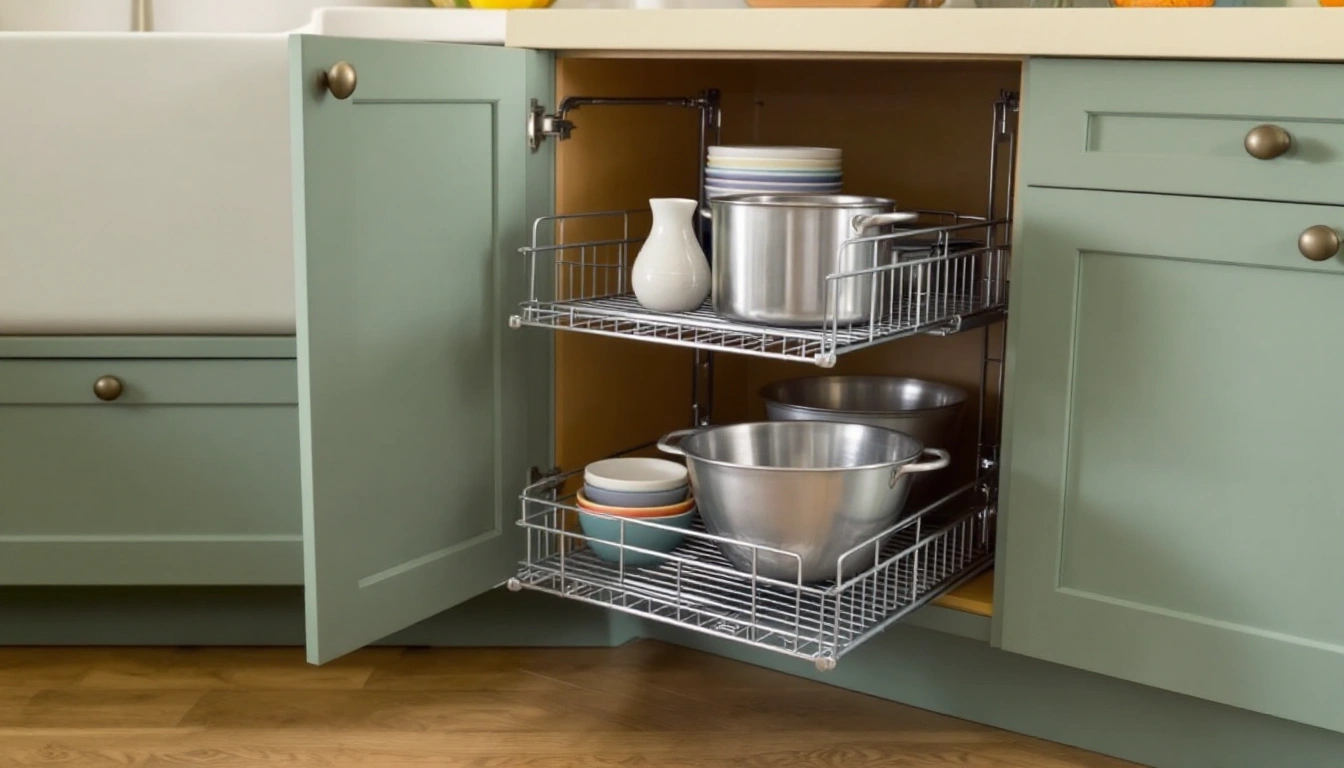
A true blind corner needs a pull-out unit built for that shape, not a lazy Susan. The Rev-A-Shelf 5PSP is the safest pick for a standard opening; the VADANIA and Kinchoix cover wider 36 inch cabinets at a lower cost.
Last updated September 2026
Contents10
- #1. Rev-A-Shelf Blind Corner Dual Pullout Organizer: best for a standard 18 inch opening
- #2. VADANIA Blind Corner Pull Out Organizer: best for a 36 inch cabinet
- #3. Kinchoix Blind Corner Pull Out Organizer: best budget 36 inch pick
- #4. Rev-A-Shelf 28 in Kidney-Shaped 2-Tier Lazy Susan: best if your corner is not actually blind
- Factors to consider when choosing a blind corner cabinet organizer
- What makes a blind corner different
- Measuring before you buy
- How we picked these blind corner cabinet organizers
- Common mistakes with blind corner installs
- Who this page is for
Our top 4 picks
- 1Best for a standard 18 inch opening
 Rev-A-Shelf Blind Corner Dual Pullout Organizer
- Fits a blind left or blind right cabinet
- Minimum 18 inch opening, fits most 48 inch blind corner cabinets
- Measures 32.38 by 21.59 by 21 inches
- 2Best for a 36 inch cabinet
 VADANIA Blind Corner Pull Out Organizer (36 in cabinet)
- Fits 36 inch blind corner cabinets, left or right opening
- Four steel baskets totaling 5.5 square feet of storage
- Hydraulic soft-close slider for smooth operation
- 3Best budget 36 inch pick
 Kinchoix Blind Corner Pull Out Organizer (36 in cabinet)
- Fits 36 inch blind corner cabinets, left or right opening
- Two tiers with four rust-resistant steel baskets
- About 4.9 square feet of total basket storage
- 4Best if your corner is not actually blind
 Rev-A-Shelf 28 in Kidney-Shaped 2-Tier Lazy Susan
- 28 inch kidney-shaped turntable with two rotating tiers
- Chrome wire construction, holds up to 64 pounds per square foot
- Telescoping shaft fits a 26 to 31 inch cabinet height
A blind corner is the cabinet space that hides behind the wall of the cabinet next to it. You can open the door, but you still cannot see or reach most of what is inside. A blind corner cabinet organizer fixes that. It pulls out and swings its baskets clear of the hidden wall, instead of just spinning in place like a lazy Susan. These four picks are built for that job.
We did not test these by hand. Details come from each listing, so check the current page before you buy.
#1. Rev-A-Shelf Blind Corner Dual Pullout Organizer: best for a standard 18 inch opening
Rev-A-Shelf Blind Corner Dual Pullout Organizer
Our verdict:
Best for a standard 18 inch opening
Best for a blind corner cabinet with an 18 inch or wider opening.
View on Amazon- Fits a blind left or blind right cabinet
- Minimum 18 inch opening, fits most 48 inch blind corner cabinets
- Measures 32.38 by 21.59 by 21 inches
- Wire frame with a three-piece ball-bearing slide
Keep in mind: it needs 21 inches of depth and 21 inches of height, so check the full spec sheet first.
Product details checked September 2026
This unit fits a blind left or blind right cabinet. It slides all the way outside the cabinet on a full ball-bearing slide. The wire baskets are adjustable, and it fits most 48 inch blind corner cabinets.
#2. VADANIA Blind Corner Pull Out Organizer: best for a 36 inch cabinet
VADANIA Blind Corner Pull Out Organizer (36 in cabinet)
Our verdict:
Best for a 36 inch cabinet
Best for a wider blind corner cabinet where you want four full baskets instead of two.
View on Amazon- Fits 36 inch blind corner cabinets, left or right opening
- Four steel baskets totaling 5.5 square feet of storage
- Hydraulic soft-close slider for smooth operation
- Baskets pull out fully for easy access
Keep in mind: check whether your cabinet opens left or right before you install it, since the bottom holder has to match.
Product details checked September 2026
This organizer switches between left-opening and right-opening blind corners. Just flip the bottom holder. Its four steel baskets total 5.5 square feet of storage, and a soft-close slide keeps them steady as they extend.
#3. Kinchoix Blind Corner Pull Out Organizer: best budget 36 inch pick
Kinchoix Blind Corner Pull Out Organizer (36 in cabinet)
Our verdict:
Best budget 36 inch pick
Best for a 36 inch blind corner cabinet on a tighter budget.
View on Amazon- Fits 36 inch blind corner cabinets, left or right opening
- Two tiers with four rust-resistant steel baskets
- About 4.9 square feet of total basket storage
- Soft-close slides for smooth, quiet operation
Keep in mind: it is not built for cabinets with granite or slate interior walls.
Product details checked September 2026
This 2-tier, 4-basket organizer also works for left and right blind corners. The steel baskets resist rust, and a soft-close slide smooths the motion. Total basket storage runs close to 4.9 square feet.
#4. Rev-A-Shelf 28 in Kidney-Shaped 2-Tier Lazy Susan: best if your corner is not actually blind
Rev-A-Shelf 28 in Kidney-Shaped 2-Tier Lazy Susan
Our verdict:
Best if your corner is not actually blind
Best for a corner cabinet that opens straight into the corner with no hidden section.
View on Amazon- 28 inch kidney-shaped turntable with two rotating tiers
- Chrome wire construction, holds up to 64 pounds per square foot
- Telescoping shaft fits a 26 to 31 inch cabinet height
- Requires the door to be hinged to the cabinet
Keep in mind: the cabinet door must be hinged to the cabinet itself, not to the lazy Susan.
Product details checked September 2026
If your cabinet's whole interior is visible when the door is open, this rotating shelf is the simpler fix. It holds up to 64 pounds per square foot. Its shaft telescopes to fit a 26 to 31 inch interior height.
Factors to consider when choosing a blind corner cabinet organizer
Confirm the cabinet is actually blind
Open the door and look straight in. If part of the cabinet clearly keeps going behind the neighboring cabinet's side wall, out of view, that is a true blind corner. If you can see the whole interior, a lazy Susan will likely work better and cost less.
Measure the opening width, not the outer cabinet
Every pull-out above lists a minimum opening width, usually 18 inches or more. That number is the clear interior opening, not the cabinet's outside size. A narrower opening will stop the mechanism from swinging all the way through.
Check door swing and depth
A blind corner pull-out needs the door open to its full swing before it can extend and rotate. Also check your cabinet depth against the product spec. The baskets need room to swing through the cabinet without hitting the back wall.
Left opening or right opening
Some of these organizers, including the VADANIA and Kinchoix, work for either a left-hinged or right-hinged blind corner. Check which one your cabinet is before you assume the unit will switch sides automatically.
What makes a blind corner different
Picture two base cabinets meeting at a right angle. One of them usually has a section that tucks behind the other cabinet's side wall. That hidden section is the blind corner. It's common in L-shaped kitchens, and it's often the least-used storage in the whole room, because reaching it means kneeling on the floor and stretching an arm into a dark gap.
A regular corner cabinet opens straight into the corner with nothing blocking the view. If you can see the back corner from the doorway, you likely don't have a true blind corner. A lazy Susan like the Rev-A-Shelf kidney at #4 will probably serve you better than a pull-out. The corner cabinet organizer page covers that shape in detail.
Buying a lazy Susan for a true blind corner, or a blind-corner pull-out for a plain corner cabinet, is a common reason for returns. The shapes aren't interchangeable, so confirm which one you have first.
Measuring before you buy
Three numbers matter. First, the face-frame opening width: the Rev-A-Shelf 5PSP needs at least 18 inches, and its listing says it fits most 48-inch blind corner cabinets. Second, the depth, since the baskets need room to travel without hitting the back wall or side panel. Third, the inside height, since the unit needs enough room to clear the frame. Each listing gives its own minimums, so check your tape measure against them rather than guessing.
Check the door separately. A blind-corner pull-out needs the door open to its full swing before it can extend. A door that only opens partway, which happens on some older cabinets, can limit how far the baskets travel even after a correct install. Open your door as wide as it goes before you assume it reaches 90 degrees.
How we picked these blind corner cabinet organizers
We looked for pull-out mechanisms built specifically for the blind corner shape, not general corner organizers. We did not test these by hand. Details come from each listing, so check the current page before you buy.
Common mistakes with blind corner installs
The most common mistake is buying a lazy Susan for a cabinet that is genuinely blind. The rotating shelf spins, but the hidden section behind the wall stays just as unreachable as before. The second mistake is skipping the depth check. A shallow cabinet can make the baskets bind partway through their travel. Compare your tape measure against the listed spec before you order.
A third mistake is loading one basket much heavier than the others. The baskets move as a set, so an uneven load adds strain to the slides over time. Spread the weight across all of them rather than using one as a dumping ground. That keeps the unit moving smoothly for longer.
Who this page is for
This page is for someone with a true blind corner, a cabinet section hidden behind the next cabinet's wall, who wants to finally use it. If your corner opens straight in, start with the lazy Susan cabinet organizer guide instead.
Questions people also ask
How do I know if I have a true blind corner cabinet?
Open the cabinet door and look inside. If part of the interior disappears behind the wall shared with the next cabinet, that is a blind corner. If the cabinet opens straight into a visible corner, it is a standard corner cabinet instead.
Will any of these fit my blind corner cabinet?
Each one lists a minimum opening width. Measure your cabinet's actual opening, not the outer cabinet size, before you order, since a narrower opening will not let the unit extend and swing properly.
What is the difference between this and a lazy Susan for corners?
A lazy Susan spins in place inside a cabinet that opens directly into the corner. A blind corner organizer pulls straight out, then swings its baskets sideways to clear the hidden wall section. Swapping one for the other usually means it will not fit.
Do blind corner organizers need professional installation?
Most mount to the existing cabinet frame or floor with standard screws, and many people install them without a contractor. Check the fit specs against your exact cabinet opening first, since these units are less forgiving of a tight space than a simple shelf.