
4 Best Flatware Organizers for Drawers in 2026
As an Amazon Associate, this website earns from qualifying purchases.
The short answer
The madesmart 3 Compartment Utensil Tray gives a matching set a soft-grip, non-slip base that guards against scratches. The Totally Bamboo organizer suits a set with serving pieces, and the Pipishell Bamboo tray fits a smaller set well.
Last updated September 2026
Contents12
- #1. madesmart Classic 3 Compartment Utensil Tray: best soft-lined protection
- #2. Totally Bamboo Expandable Drawer Organizer: best for a set with serving pieces
- #3. Pipishell Bamboo Expandable Silverware Organizer: best for a smaller matching set
- #4. Lifewit Expandable Silverware Organizer: best budget option for daily-plus-formal mixing
- Factors to consider when choosing a flatware organizer for drawer use
- Why a formal set needs more than a basic tray
- When the set is uniform in size
- How much to spend on the organizer
- Fitting a large set into one drawer
- How we picked each flatware organizer for drawer use
- Caring for a set you want to last
- Who this guide is for
Our top 4 picks
- 1Best soft-lined protection
 madesmart Classic 3 Compartment Utensil Tray
- Three spacious compartments for kitchen utensils
- Measures 16 by 13 by 1.87 inches
- Soft-grip lining and nonslip rubber feet
- 2Best for a set with serving pieces
 Totally Bamboo Expandable Drawer Organizer
- Expands from 13 to 22 inches wide
- Five compartments, three fixed and two sliding
- Measures 17.75 inches deep by 2.5 inches high
- 3Best for a smaller matching set
 Pipishell Bamboo Expandable Silverware Organizer
- Six to eight compartments for forks, spoons and knives
- Expands from 13 to 19.6 inches wide
- Made from premium bamboo
- 4Best budget option for daily-plus-formal mixing
 Lifewit Expandable Silverware Organizer
- Expands from 8 to 13.8 inches wide
- Seven compartments for sorting forks, spoons and knives
- Made from sturdy PP plastic
A flatware organizer for drawer use needs to do more than fill slots when the set is formal or matching. The goal is keeping pieces from scratching each other. Serving pieces need their own space, not a squeeze into a fork-sized slot. This guide compares four picks for that job.
We did not test these by hand. The facts below come from each listing. Check the current page before you buy.
#1. madesmart Classic 3 Compartment Utensil Tray: best soft-lined protection
madesmart Classic 3 Compartment Utensil Tray
Our verdict:
Best soft-lined protection
Best for a matching set you want to protect from scratches and clinking in a bare tray.
View on Amazon- Three spacious compartments for kitchen utensils
- Measures 16 by 13 by 1.87 inches
- Soft-grip lining and nonslip rubber feet
- Made from BPA-free plastic
Keep in mind: its three sections are wide and general-purpose, not cut to fit each flatware type precisely.
Product details checked September 2026
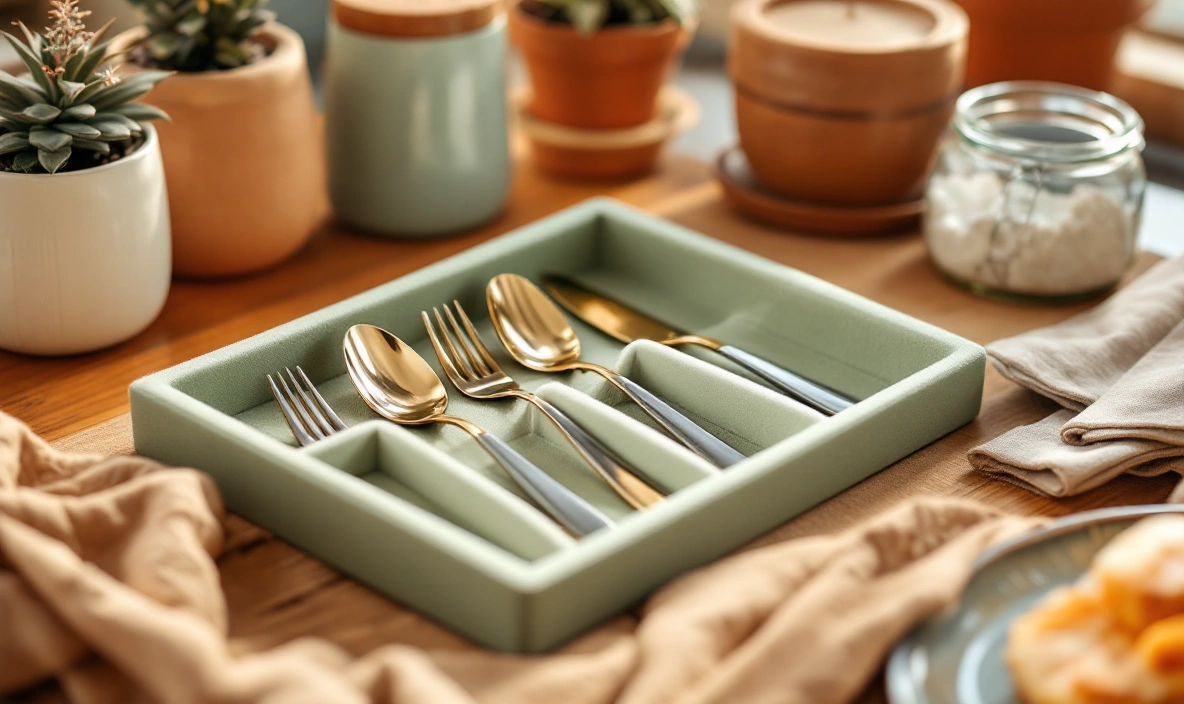
This tray has a soft-grip lining and a non-slip base. That cushions pieces against each other. It also keeps the tray from shifting when the drawer opens.
#2. Totally Bamboo Expandable Drawer Organizer: best for a set with serving pieces
Totally Bamboo Expandable Drawer Organizer
Our verdict:
Best for a set with serving pieces
Best for a matching set that includes a serving spoon, meat fork, or other pieces longer than everyday forks and knives.
View on Amazon- Expands from 13 to 22 inches wide
- Five compartments, three fixed and two sliding
- Measures 17.75 inches deep by 2.5 inches high
- Bamboo sidewalls with a fiberboard base
Keep in mind: its five sections run wider than a dedicated cutlery tray, so slim everyday pieces get a looser fit.
Product details checked September 2026
This tray expands from 13 to 22 inches with five sections. Some sections fit serving pieces and larger tools. If your set has anything longer than standard flatware, this tray handles it better than a uniform one.
#3. Pipishell Bamboo Expandable Silverware Organizer: best for a smaller matching set
Pipishell Bamboo Expandable Silverware Organizer
Our verdict:
Best for a smaller matching set
Best for a smaller matching set of everyday-size pieces without oversized serving items.
View on Amazon- Six to eight compartments for forks, spoons and knives
- Expands from 13 to 19.6 inches wide
- Made from premium bamboo
- Wipes clean with a damp cloth
Keep in mind: it needs a wipe down instead of a dishwasher cycle, so it takes more care than plastic.
Product details checked September 2026
This tray expands from 13 to about 19.6 inches, with six to eight sections. Bamboo resists scratching better than bare plastic. It also looks more finished if the drawer is one guests might see.
#4. Lifewit Expandable Silverware Organizer: best budget option for daily-plus-formal mixing
Lifewit Expandable Silverware Organizer
Our verdict:
Best budget option for daily-plus-formal mixing
Best for sharing a drawer between everyday cutlery and a smaller matching set, without a big budget.
View on Amazon- Expands from 8 to 13.8 inches wide
- Seven compartments for sorting forks, spoons and knives
- Made from sturdy PP plastic
- Hand wash recommended to keep its shape
Keep in mind: it is built for everyday forks, spoons, and knives, not oversized serving pieces, so check your set's sizes first.
Product details checked September 2026
This tray expands from 8 to 13.8 inches, with seven sections. It is a lower-cost way to give a matching set its own slots. This works as long as none of the pieces run especially long.
Factors to consider when choosing a flatware organizer for drawer use
Look for lining or separation, not just slots
Everyday cutlery is usually stainless steel. It is not precious about small scratches. A formal set is often something you want to keep in good shape. A soft lining or enough separation between slots reduces the clinking and scratching a bare tray allows.
Check for a slot sized for serving pieces
A matching set often includes a serving spoon or meat fork longer than the rest. Wedging these into a standard slot either fails or leaves them sticking out. Look for a tray with one wider or longer section if your set includes pieces like this.
Decide if the set needs its own drawer
Many households keep a formal set apart from daily cutlery. It gets touched less, so it wears less too. If space is limited, give the formal set the lined slots. Let everyday cutlery use the plainer ones.
Why a formal set needs more than a basic tray
Everyday cutlery is usually stainless steel, easy to replace, and not fussy about small scratches. A formal or matching set is often something people care more about, whether it's a wedding set, an inherited set, or a nicer set kept for guests. A bare plastic tray lets pieces clink and slide against each other every time the drawer opens. Over years of use, that adds up.
A soft lining cuts down that contact. That is why the madesmart tray, with its soft-grip lining and rubber feet, leads this list. It is not a cutlery-specific tray, but its three large sections work for flatware as long as the pieces fit them reasonably well.
When the set is uniform in size
Not every matching set includes long serving pieces. If yours is just forks, knives and spoons of similar length, a silverware tray with more, narrower slots, like the Pipishell (six to eight sections) or the Lifewit (seven), gives each piece its own lane. That is the simpler, lower-cost route if you mainly want a clean, set spot for each piece.
How much to spend on the organizer
Think about the organizer's cost next to the value of the set. A high-value inherited or wedding set justifies a well-lined, well-built tray, since the tray costs little next to replacing scratched pieces. For a moderately priced set used a few times a year, a simpler lined tray is usually enough.
Fitting a large set into one drawer
A full formal set, especially one for eight or twelve place settings plus serving pieces, can be more than one standard drawer holds comfortably. Count your pieces by type and compare that with the slot count of the tray you're considering. If it won't fit easily, split the set: everyday-size pieces in one tray and serving pieces in a separate slot or drawer.
Leave a little extra room rather than filling every slot to the limit. A tightly packed tray makes it hard to lift pieces out without them scraping their neighbors.
How we picked each flatware organizer for drawer use
We looked for trays with soft linings, separation between slots, or wider sections built for serving pieces. Those features matter most for a set worth protecting. We did not test these by hand. Details come from each listing, so check the current page before you buy.
Caring for a set you want to last
Dry pieces before they go back into the tray. Do not put them away damp. Moisture sitting against a lined slot for long stretches can speed up tarnishing, especially with silver-plated pieces.
Who this guide is for
This guide is for someone organizing a matching or formal flatware set they want to protect with extra care. If you are organizing daily-use cutlery instead, our cutlery drawer organizer and silverware drawer organizer picks cover that more common case.
Questions people also ask
Does a formal flatware set need a different organizer than everyday cutlery?
It benefits from one, mainly because formal sets are often heavier and can scratch each other in a bare tray with no lining. A softer-lined tray protects the finish better.
How do I store serving pieces from a matching set?
Look for a tray with at least one wider or longer slot sized for serving pieces, rather than fitting them into standard fork or spoon slots. A few trays in this guide include that kind of slot.
Is bamboo or lined plastic better for a formal flatware set?
Both protect against scratching better than a bare plastic tray with no lining. Bamboo suits a set you want to look intentional in a visible drawer. A soft-lined plastic tray is a lower-cost way to get similar protection.
Should I keep formal flatware in a separate drawer from everyday cutlery?
It is not required, but many people do, mainly because a formal set is used less often and stays in better shape untouched between uses.